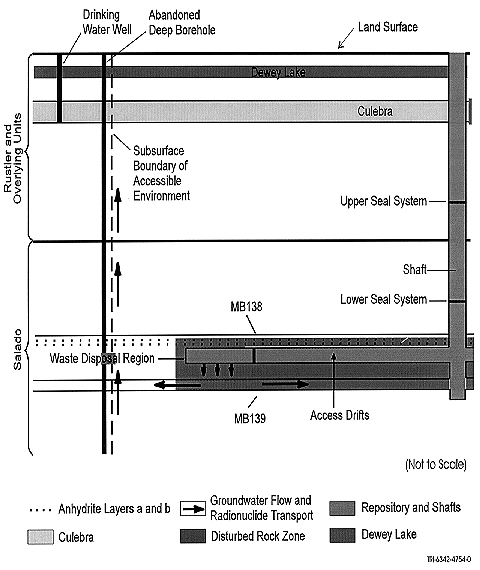
Fig. 1.Bounding approach.
John S. Hart
John Hart and Associates, P.A.
Albuquerque, New Mexico
Barbara J. Graves
Ark Environmental Services
Albuquerque, New Mexico
ABSTRACT
The DOE must demonstrate that the Waste Isolation Pilot Plant (WIPP) may be operated and closed in compliance with the provisions and requirements of U.S. Environmental Protection Agency (EPA) standard 40 CFR Part 191, Environmental Radiation Protection Standards for Management and Disposal of Spent Nuclear Fuel, High-Level and Transuranic Radioactive Wastes (1). Part 191 includes Subpart C, which provides environmental standards for ground water.
This paper reports DOE's progress in demonstrating that the WIPP complies with the provisions of Subpart C of Part 191. This work includes a determination of whether any underground water body near the WIPP meets the definition of an underground source of drinking water (USDW), as defined in the regulation. In performing this determination it was necessary for the DOE to develop criteria to be applied to water quality and quantity data from wells located near the WIPP. The determination also required a review and summary of relevant literature pertaining to ground water quality and quantity in the study area. The DOE criteria and their bases are described and conclusions of the data review are summarized. As a result of this work, the DOE has concluded that USDWs may be located within the WIPP land withdrawal area (LWA) and to the east of the LWA and that a USDW is located about one mile to the southwest of the LWA boundary.
In addition, the DOE performed bounding analyses of the potential impacts to USDWs from releases of radionuclides from the WIPP repository under undisturbed conditions. The transport pathway to the accessible environment and predicted releases are described. Resulting concentrations and doses are compared to the National Primary Drinking Water Standards. Based on this work, the DOE has documented that the WIPP will comply with the ground water protection provisions of Subpart C of 40 CFR Part 191.
Information presented in this paper summarizes part of Chapter 8 of the WIPP Compliance Certification Application (2) (CCA) which was prepared by the DOE and submitted to the EPA on November 29, 1996. The CCA provides documentation to the EPA and other interested parties that the WIPP will comply with the requirements of 40 CFR Part 191.
GROUND WATER PROTECTION REQUIREMENTS
The DOE must demonstrate that the WIPP may be operated and closed in compliance with the provisions and requirements of applicable EPA environmental radiation protection standards. Among the applicable regulations is 40 CFR Part191, Environmental Radiation Protection Standards for Management and Disposal of Spent Nuclear Fuel, High-Level and Transuranic Radioactive Wastes. Part 191 includes Subpart C, which provides environmental standards for ground water. Specifically, the standard requires [§191.24(a)(1)]:
Disposal systems for waste and any associated radioactive material shall be designed to provide a reasonable expectation that 10,000 years of undisturbed performance after disposal shall not cause the levels of radioactivity in any underground source of drinking water, in the accessible environment, to exceed the limits specified in 40 CFR part 141 as they exist on January 19, 1994.
EPA rule 40 CFR Part 141 (3) specifies the National Primary Drinking Water Standards. The levels of radioactivity (and dose equivalent in the case of § 141.16[a]) specified in 40 CFR Part 141, as of January 19, 1994 were:
In addition, the DOE must demonstrate compliance with 40 CFR Part 194, EPA's Criteria for the Certification and Re-Certification of the Waste Isolation Pilot Plant's Compliance with the 40 CFR Part 191 Disposal Regulations (4). Section 194.53 applies to DOE's consideration of underground sources of drinking water (USDWs). The criterion specifies:
In compliance assessments that analyze compliance with part 191, subpart C of this chapter, all underground sources of drinking water in the accessible environment that are expected to be affected by the disposal system over the regulatory time frame shall be considered. In determining whether underground sources of drinking water are expected to be affected by the disposal system, underground interconnections among bodies of surface water, ground water, and underground sources of drinking water shall be considered.
COMPLIANCE APPROACH
To assess compliance with these provisions of the regulations, it is necessary to identify any USDW which may be located near the WIPP. To perform this evaluation, it was necessary to establish criteria to be applied to water quality and quantity data from wells in the vicinity of the WIPP. The criteria must be based on the regulatory definition of a USDW, as provided in 40 CFR §191.22. The rule defines a USDW as an aquifer or its portion that:
"Public water system" means a system for the provision to the public of piped water for human consumption, if such system has at least fifteen service connections or regularly serves at least twenty-five individuals. Such term includes:
"Total dissolved solids" means the total dissolved (filterable) solids in water as determined by use of the method specified in 40 CFR Part 136.
Criteria based on these definitions were developed by the DOE and are applied to the assessment of the presence of any USDW near the WIPP.
Ground Water Quantity
Two sub-criteria have been identified by the DOE and applied to the ground water quantity definition:
Water-consumption information was evaluated by the DOE to define the first sub-criterion (the ability to produce at an adequate rate). The value to be applied is determined by obtaining the following information:
To be conservative in the definition of a USDW, the lower of these two values is assigned to the first sub-criterion. A quantity of 5 gallons per minute is assigned as the first sub-criterion. This value was derived through a review of U.S. Census Bureau statistics on per capita water consumption in communities in Southeastern New Mexico.
The definition of the second quantity sub-criterion (the acceptable production duration from a well) is more subjective. Because the creation of a public water supply system involves considerable capital expense, it is reasonable to assume that such a water system would not be constructed unless the water source would continue to be available for some time, at least long enough to recover the capital expense. The Rural Utility Service of the U.S. Department of Agriculture provides loans for funding new rural water supply systems. The loan periods are generally 40 years in duration. Based on this, a duration of 40 years is applied by the DOE to the second quantity sub-criterion.
Ground Water Quality
A criterion of 10,000 milligrams per liter of TDS is specified in 40 CFR §191.22. Any aquifer or its portion producing water having TDS concentrations below this level is determined to be producing water that meets the quality criterion for a USDW. Any aquifer or its portion producing water having TDS concentrations at or above this level is determined to be producing water that does not meet the quality criterion and the regulatory definition of a USDW.
USDWs Near the WIPP
Once the criteria for making a USDW determination were selected, relevant data sources and literature pertaining to ground water quality and quantity in the vicinity of the WIPP were reviewed. As a result of this work, the DOE has concluded that USDWs may be located within the WIPP LWA and approximately two miles to the east of the LWA and that a USDW is located about one mile to the southwest of the LWA boundary.
Some uncertainty remains regarding the locations of the boundaries of the USDWs. This is primarily because data pertaining to the duration of flow from wells is limited.
Results of Analysis
The ground water protection provisions of Subpart C of 40 CFR Part 191 are based on the undisturbed performance of the repository. Undisturbed performance is defined in 40 CFR Part 191 to mean "the predicted behavior of a disposal system, including consideration of the uncertainties in predicted behavior, if the disposal system is not disrupted by human intrusion or the occurrence of unlikely natural events" (40 CFR§ 191.12).
The rule (40 CFR §194.52) specifies that compliance assessments consider "all potential pathways from the disposal system to individuals." The DOE has considered the following potential pathways for ground water flow and radionuclide transport:
After considering all of these, the DOE has found two pathways by which contaminated brine could migrate away from the WIPP waste-disposal panels, if pressure within the panels is elevated by the generation of gas from corrosion or microbial degradation. The two credible pathways by which radionuclides could reach the accessible environment are:
These conceptual release pathways for undisturbed performance are illustrated in Fig. 1. Although both pathways are possible, the performance assessment modeling performed for the project indicates that under undisturbed conditions, only the first is a potential pathway during the 10,000-year period of interest specified in the regulation.
Three hundred realizations of the modeling system were generated to evaluate undisturbed performance. These 300 realizations are comprised of three sets of 100 realizations each, generated using the Latin Hypercube sampling method. Of the 300 realizations, none show any radionuclides reaching the top of the Salado through the sealed shafts.
Nine of the 300 realizations show concentrations of radionuclides greater than zero reaching the accessible environment through the anhydrite interbeds. All of the remaining 291 realizations show that no radionuclides reach the accessible environment during 10,000 years through the anhydrite interbeds. This transport pathway is assessed for the evaluation of compliance with the ground water protection standard.
Fig. 1.Bounding approach.
Uncertainty is inherent in the calculation of radionuclide concentrations in the anhydrite interbeds and in the calculation of doses resulting from the specified exposure pathway. Given this uncertainty, the DOE has elected to perform a bounding analysis using assumptions that do not represent reality, but that would result instead in a bounding estimate that is much greater than any reasonably expected contribution of contaminants to a USDW or dose to a receptor. If this unrealistic yet bounding analysis results in calculated concentrations and doses to a receptor that are below the regulatory limit, compliance with the standard is demonstrated. The bounding analysis used for this assessment is based on the following factors and assumptions:
The analysis is based on an assumption that a USDW is located such that the maximum possible concentration of radionuclides could be realized in the USDW and the maximum possible dose to an individual who drinks from the USDW could be delivered to the individual. As such, the analysis bounds the 40 CFR § 194.53 criterion that specifies that DOE must consider underground interconnections among bodies of surface water, ground water, and USDWs.
COMPLIANCE ASSESSMENT
Assuming the transport pathway described above and applying the very conservative bounding approach, the DOE has developed estimates of radionuclide concentrations that could be realized in a USDW near the WIPP and doses that could be delivered to an individual who drinks from the USDW. These estimates are compared to the National Primary Drinking Water Standards.
The conclusions of this work illustrate that the consequences of the undisturbed repository are negligible, even when unrealistic assumptions are applied to the performance evaluation.
Combined 226Ra and 228Ra
The modeling system employed to simulate the performance of the undisturbed repository tracks the transport of the radionuclides of greatest importance to releases to the accessible environment. These radionuclides of interest are 241Am, 239Pu, 238Pu, 234U, and 230Th. The modeling system does not specifically track 226Ra or 228Ra because these radionuclides are only a minor component of the entire projected inventory of the repository. However, an analysis of 226Ra and 228Ra is required to evaluate compliance with the ground water protection standard.
To perform the bounding analysis, the results of a tracer exercise of the NUTS code were used to scale the anticipated releases of 226Ra and 228Ra. The tracer exercise shows that an initial concentration of radionuclides in the repository of 1 kilogram per cubic meter results in a concentration at the accessible environment boundary of 2.5 (breve) 10-7 kilograms per cubic meter. By applying this scaling factor determined by the tracer exercise to the quantity of 226Ra and 228Ra projected to be emplaced in the repository, it is determined that the maximum concentration of these radionuclides in the accessible environment is 2 picocuries per liter, which is below the 40 CFR § 141.15(a) standard of 5picocuries per liter.
Gross Alpha Particle Activity Including 226Ra But Excluding Radon and Uranium
Compliance with the 40 CFR §141.15(b) standard was assessed by summing the maximum concentration values for 241Am, 239Pu, 238Pu, and 230Th and adding the value for 226Ra obtained to perform the 40 CFR § 141.15(a) assessment. The value obtained by this method is 7.81 picocuries per liter, which is below the 40 CFR §141.15(b) standard of 15 picocuries per liter. This concentration occurs in the anhydrite interbeds within the Salado and not in a zone that could realistically be expected to be a source of drinking water.
Annual Dose Equivalent to the Total Body or Any Internal Organ from the Average Annual Concentration of Beta Particle and Photon Radioactivity from Man-Made Radionuclides
To assess compliance with the 40 CFR §141.16(a) standard, an annual dose equivalent of 4 millirem per year, the transport of the following radionuclides was evaluated: 239Pu, 238Pu, 234U, and 230Th. The maximum annual committed effective dose from any of these radionuclides is 0.47 millirems, which is an order-of-magnitude below the regulatory standard. The 0.47 millirem value includes alpha particle radioactivity, as well as beta particle and photon radioactivity. Thus, the value is very conservative in that the 4 millirem annual dose equivalent limit is only for beta particle and photon radioactivity.
COMPLIANCE SUMMARY
In performing the WIPP compliance assessment, the DOE applied a bounding-analysis approach using unrealistic assumptions that result in the over estimation of potential doses and contaminant concentrations. To provide added assurance, the DOE assumed the presence of a USDW in close proximity to the WIPP Land Withdrawal Area boundary, even though available data are inconclusive regarding the proximity of the nearest USDW. Using this very conservative approach, the calculated maximum concentrations of contamination in the hypothetical USDW would be less than half of the EPA ground water protection limits and the maximum potential dose to a receptor who drinks from the hypothetical USDW would be an order of magnitude less.
This conservative approach also assumes that all contaminants reaching the accessible environment are directly available to a receptor. The analysis bounds any potential impacts of underground interconnections among bodies of surface water, ground water, and underground sources of drinking water.
REFERENCES
This paper reports work performed by the Westinghouse Electric Corporation under prime contract DE-AC04-86AL31950 with the U.S. Department of Energy (DOE).