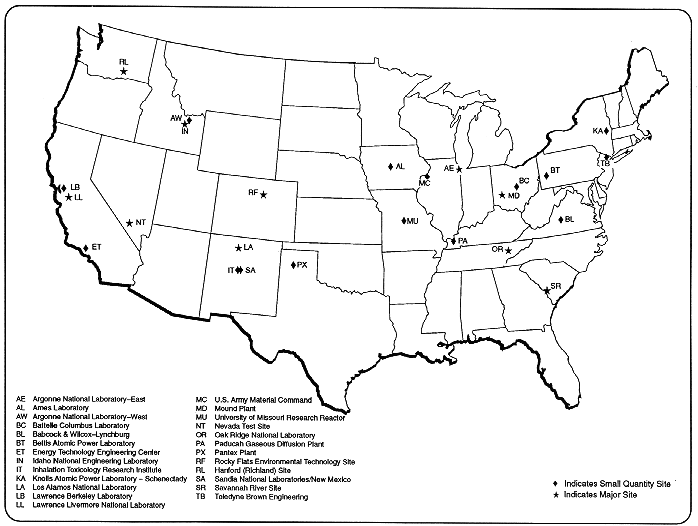
Fig. 1. U.S. Department of Energy
transuranic waste generator/storage sites.
R. Stroud and R. Bisping*
Department of Energy-Carlsbad Area Office
Carlsbad, NM
P. Drez
Drez Environmental Associates
Albuquerque,
NM
S. Chakraborti, D. Bretzke, J. McCann
Science
Applications International Corporation
Albuquerque, NM
J. Harvill
Advanced Sciences Incorporated
Albuquerque, NM
ABSTRACT
The U. S. Department of Energy (DOE) is in the process of providing regulatory submissions to State/Federal agencies, which if approved, will allow DOE to dispose of transuranic (TRU) waste in the Waste Isolation Pilot Plant (WIPP), a deep geological repository near Carlsbad, New Mexico. All the regulatory submissions require an inventory of the TRU waste expected to be shipped to and disposed of in the WIPP. The Transuranic Waste Baseline Inventory Report (TWBIR) is the document developed by DOE to satisfy the need for such inventories.
The primary purpose of the TWBIR is to provide data to be included in the Sandia National Laboratory/New Mexico (SNL/NM) performance assessment (PA) processes. Besides supporting regulatory submittals, the TWBIR also supports other DOE programs for providing the total DOE TRU waste inventory. Therefore, the TWBIR includes information on the total DOE TRU waste inventory, including nondefense, commercial, PCB-contaminated, and buried TRU wastes.
The TWBIR establishes a methodology for grouping wastes of similar physical and chemical properties from across the DOE TRU waste system into a series of "waste profiles." The TWBIR uses waste stream information provided by the DOE TRU waste sites. Each waste stream is defined in a waste stream profile and has been assigned to a Final Waste Form by the DOE TRU waste sites.
The WIPP anticipated (stored and projected) inventory of TRU waste is defined as the sum of retrievably stored waste plus currently projected TRU waste volumes. The anticipated inventory for contact-handled (CH)-TRU waste is not sufficient to fill the maximum CH-TRU disposal inventory for WIPP (5,950,000 cubic feet or 168,500 cubic meters). "Scaling" has been developed as a means for SNL/NM to model the impacts of a full repository. Scaling has not been applied to the RH-TRU inventory since the sites have reported sufficient RH-TRU waste to fill the remote-handled (RH)-TRU disposal inventory (250,000 cubic feet or 7,080 cubic meters).
The TWBIR also estimates the WIPP disposal inventory in terms of 12 waste material parameters (e.g., iron-based metal/alloys, cellulosics, plastics, etc.) and additional packaging materials that have been identified by SNL/NM as necessary for PA. The waste material parameters in the waste stream, site-specific, and WIPP waste profiles are expressed on a weight/volume (kilograms per cubic meter) basis. Radionuclide information scaled to fill the WIPP repository is also provided for PA analyses.
INTRODUCTION
The Waste Isolation Pilot Plant (WIPP) is a transuranic (TRU) waste management facility operated by the U.S. Department of Energy (DOE), located near Carlsbad, New Mexico. The WIPP is currently identified as the permanent disposal site for DOE TRU waste.
TRU waste is defined as waste that is contaminated with alpha-emitting radionuclides having an atomic number greater than 92, with half-lives greater than 20 years, and concentrations of TRU isotopes greater than 100 nanocuries per gram of waste at the time of assay (1). TRU wastes are classified as either contact handled (CH) or remote handled (RH), depending on the dose rate at the surface of the waste container. CH-TRU wastes are packaged TRU wastes with an external surface dose rate of 200 millirems (mrem) or less per hour, while RH-TRU wastes are packaged TRU wastes with an external surface dose rate exceeding 200 mrem per hour (2). Unless otherwise indicated, for purposes of this document, all references to TRU waste include both nonmixed and mixed TRU waste (waste that contains both radioactive and hazardous components, as defined by the Atomic Energy Act and the Resource Conservation and Recovery Act [RCRA]).
The DOE is committed to demonstrating compliance with all applicable regulations prior to permanent disposal of TRU wastes in the WIPP repository. These regulations are the environmental standards for management and disposal of TRU wastes as mandated in Title 40, Code of Federal Regulations (CFR) Part 191 (3) and Part 194 (4), and the RCRA regulations codified in 40 CFR Parts 264, 265, 268, and 270 (5-8). The WIPP is currently scheduled to receive and dispose of TRU wastes from 10 major and several minor TRU waste sites (see Fig. 1). Compliance will be demonstrated through performance assessment (PA) calculations based on the inventory of existing and projected waste streams developed from data submitted by the DOE TRU waste sites. This paper describes the methodology used to derive the inventories used in the PA calculations.
Fig. 1. U.S. Department of Energy
transuranic waste generator/storage sites.
HISTORY
The Transuranic Waste Baseline Inventory Report (TWBIR) establishes a methodology for grouping wastes of similar physical and chemical properties from across the DOE TRU waste system into a series of "waste profiles" that can be used as the basis for waste form discussion with regulatory agencies.
Revision 0 of the Baseline Inventory Report was first published by the DOE in June 1994 (9) with the primary purpose of documenting the disposal inventory of TRU waste to be placed in WIPP as defined by the DOE TRU waste sites. The original title for the first two revisions (Revision 0 and Revision 1) (10) of the report was the WIPP Transuranic Waste Baseline Inventory Report (WTWBIR) because these revisions only reported TRU waste that was to be disposed of in the WIPP. The data in the WTWBIR were to be used by Sandia National Laboratories, New Mexico (SNL/NM) in WIPP PA calculations.
Revision 0 of the WTWBIR was the first attempt ever made by DOE to report all of its TRU waste at the waste stream level, including data for both mixed and nonmixed TRU waste streams. The data in the Final Phase Mixed Waste Inventory Report (MWIR) (11) formed the basis for the mixed TRU waste streams reported in WTWBIR, Revision 0. The volumes for nonmixed TRU waste streams reported in Revision 0 were mathematically estimated. The data in Revision 0 were considered preliminary until quality checks of the data were completed by the sites for Revision 1 of the WTWBIR.
Revision 1 of the WTWBIR, published in February 1995, collected waste stream level data directly from the TRU waste sites (through a questionnaire) for both mixed and nonmixed waste streams and added any changes requested by the DOE sites. The DOE Carlsbad Area Office (CAO) instituted a meeting with each updated questionnaire to explain to the TRU waste sites in detail the data needs for PA and guidelines for filling out the questionnaire. These meetings resulted in overall better questionnaire data sets submitted by the TRU waste sites. In addition, Revision1 was the first attempt by DOE to report TRU waste volumes in their expected final forms (i.e., after the waste is processed to meet Waste Acceptance Criteria (2] for WIPP, if necessary).
In response to additional data needs, DOE expanded the scope of TWBIR Revision 2 to include all DOE TRU waste whether or not the waste is planned to be disposed of in the WIPP. In addition, Revision 2 also collected TRU waste information to support other DOE programs such as the WIPP RCRA Part B Permit Application (12), WIPP transportation studies, the Second Supplemental Environmental Impact Statement (SEIS-II) for the WIPP Disposal Phase, and others. Consequently, the title of the document has changed to the "TWBIR." Revision2 was published in December 1995 (13). Revision 3, which was published in June 1996 (14), is based on Revision 2 waste stream data supplemented by additional information from the TRU waste sites required by DOE to evaluate WIPP's anticipated performance.
Because of the increasing scope of the TWBIR over the past two years in providing TRU waste data for different DOE programs, the information contained in the TWBIR is more detailed at the waste stream level than any of the other previous published documents on TRU waste (15-17).
The main purpose of the TWBIR since its inception has been to be the inventory basis for the Compliance Certification Application (18) to the Environmental Protection Agency--Office of Radiation and Indoor Air, which is one of the last regulatory hurdles before the opening of WIPP. The TWBIR will be updated as needed to support WIPP programs. The updates will be based on revised data submittals from the TRU waste sites.
INVENTORY TERMINOLOGY
Stored Inventory
The part of the TRU inventory currently in retrievable storage at the time of the last data call for inventory information is known as "stored inventory." For Revisions 2/3, stored waste usually includes waste in storage as of December 31, 1994. Retrievably stored waste includes waste stored since approximately 1970 in buildings or in berms with earthen cover and does not include any waste that was buried prior to 1970 (19).
As Generated Waste
The chemical and physical status of waste when it is generated. The "As-Generated" term applies to both stored and future generation waste.
Projected Inventory
The part of the TRU inventory that has not been generated but is currently estimated to be generated at some time in the future by the TRU waste sites. For Revision 3, this includes waste scheduled for generation from calendar year (CY) 1995 to 2022. "Newly generated waste" is sometimes used as a synonym for the projected inventory.
Anticipated Inventory
For the TWBIR, this is the sum of the stored and projected inventories.
Scaling
The process for adjusting, if needed, the projected inventory to the design limit (disposal inventory) of the WIPP repository.
Disposal Inventory
The inventory volume defined for WIPP emplacement to be used for PA calculations. The Land Withdrawal Act (LWA) defines the total amount of TRU waste allowed for disposal in the WIPP as 6,200,000 cubic feet (175,600 cubic meters) (20). The "Agreement for Consultation and Cooperation" (C&C Agreement) limits the RH-TRU inventory to 250,000 cubic feet (7,080 cubic meters) (21). Therefore, the CH-TRU inventory will be limited to 5,950,000 cubic feet (168,500 cubic meters) if all of the RH-TRU allowance is filled.
Disposal Inventory = Stored Inventory + Projected Inventory (Scaled as Needed)
METHODOLOGY
Waste Stream Profile
Each DOE TRU waste site provided data packages that contained characterization information for each waste stream. This characterization information includes, but is not limited to, the following: waste stream description, waste stream source description, identification codes, Final Waste Form, as-generated volumes, Final Waste Form volumes, waste material parameter concentrations, hazardous waste codes, etc. An example of a "waste stream profile" from the Rocky Flats Environmental Technology Site (RF-TT0440) from TWBIR Revision 2 is provided in Fig. 2. Additional explanation of the content of the different fields for a waste stream profile can be found in Appendix C of TWBIR Revision 2 (13).
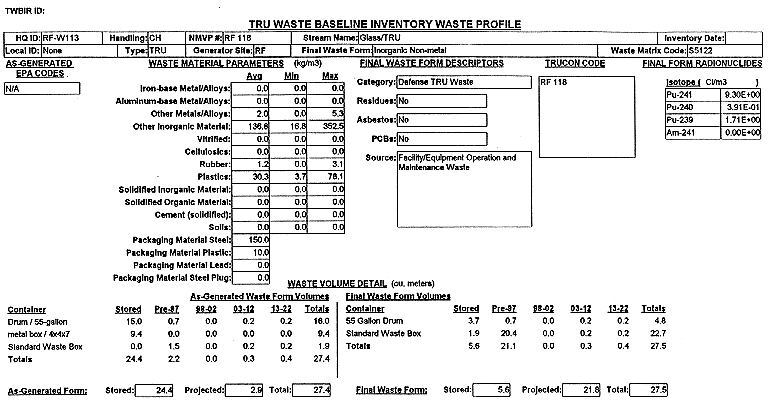
Fig. 2. Example of Waste Stream
Profile.
Each TRU waste site, for each waste stream, has been requested to identify the "Final Waste Form." "Final Waste Form" of a waste stream refers to the expected physical and chemical form of that stream once the waste has been treated or repackaged (if necessary) and is ready for transportation and disposal. The use of the Final Waste Form helps to group waste streams that are expected to have similar physical and chemical properties at the time of disposal. The Final Waste Form applies to both stored and projected waste. Waste streams that are currently designated as "unknown waste" cannot be accepted for disposal in the WIPP until further characterization information is available. The 11 TWBIR Final Waste Form categories are listed below:
Waste streams, as waste stream profiles, at each TRU waste site with similar Final Waste Forms are grouped together to generate the site-specific waste profiles. In other words, a site-specific waste profile presents a roll-up of the data for all waste streams at a given site that have the same Final Waste Form. The grouping of individual waste stream profiles into a site-specific waste profile is based on the similar physical and chemical properties of the waste streams and how that information is used in the WIPP PA models.
For example, glass waste, firebrick waste, and ceramic waste, due to their similar properties for PA modeling mainly influence the estimation of porosity and permeability in the PA calculations. Therefore, the three waste streams within a DOE TRU waste site can be grouped together and placed into the site-specific waste profile "inorganic nonmetal." A site-specific waste profile is developed at each of the TRU waste sites for each of the Final Waste Forms that have individual waste streams at the site.
The WIPP waste profiles are the highest tier of information in the TWBIR. Site-specific waste profiles with the same Final Waste Form are combined across the TRU waste sites into what is identified as an overall WIPP waste profile. To illustrate the methodology for grouping similar site-specific waste profiles into WIPP waste profiles, an example of a possible CH-TRU WIPP waste profile for "inorganic nonmetal" waste is provided in Fig. 3. There can be a maximum of 11 possible WIPP waste profiles for CH-TRU waste and 11 possible WIPP waste profiles for RH-TRU waste.
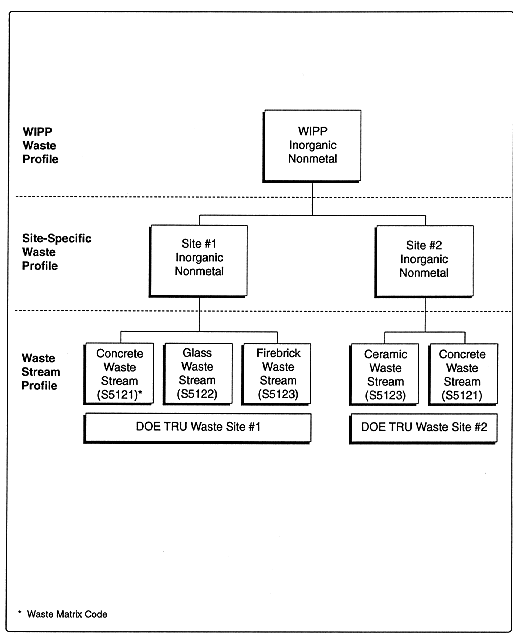
Fig. 3. Schematic of Waste Stream
Profile Methodology.
CALCULATION OF ANTICIPATED INVENTORIES
The Final Waste Form volumes for all waste streams reported in the TWBIR (13, 14) are summarized in Tables I and II as the total stored and projected (CY 1995-2022) volumes of CH-TRU and RH-TRU by TRU waste site.
CALCULATION OF DISPOSAL INVENTORIES
The WIPP anticipated inventory of TRU waste is defined as the sum of retrievably stored waste plus currently projected TRU waste volumes (CY 1995-2022). The anticipated inventory for CH-TRU waste (see Table I) is not sufficient to fill the maximum calculated CH-TRU disposal inventory for WIPP (168,500 cubic meters). Scaling of the projected Final Waste Forms has been developed as a means for SNL/NM to model the impacts of a full repository. Scaling has not been applied to the RH-TRU inventory since the sites have reported sufficient RH-TRU waste to fill the RH-TRU disposal inventory (7,080 cubic meters).
Waste Material Parameters
The TWBIR also estimates the WIPP disposal inventory in terms of 12 waste material parameters and additional packaging materials that have been identified by SNL/NM as necessary for PA. The 12 waste material parameters and additional packaging materials are waste constituents of TRU waste and are input parameters for one or more PA models or are required to adequately describe the waste form. The 12 waste material parameters and additional packaging materials are listed below:
Waste Material Parameters
Iron-base metal/alloys - Rubber-
Aluminum-base metal/alloys - Plastics
Other metal/alloys - Vitrified
Other inorganic materials - Cellulosics
Solidified inorganic material - Soils
Solidified organic material - Cement (solidified)
Packaging Materials
Steel - Plastic
Lead (for RH-TRU waste only)
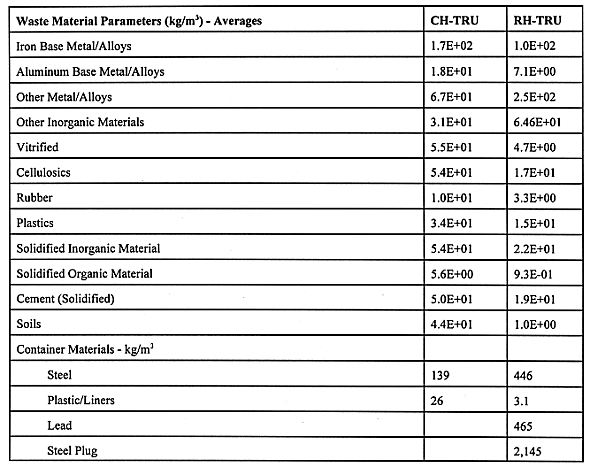
The waste material parameters are expressed on a weight/volume (kilograms/m3) basis. Table III presents the average waste material parameters for CH-TRU and RH-TRU waste after scaling to fill the repository for CH-TRU waste, as used in PA calculations (14).
Table I WIPP CH-TRU Waste Anticipated Inventory by Site
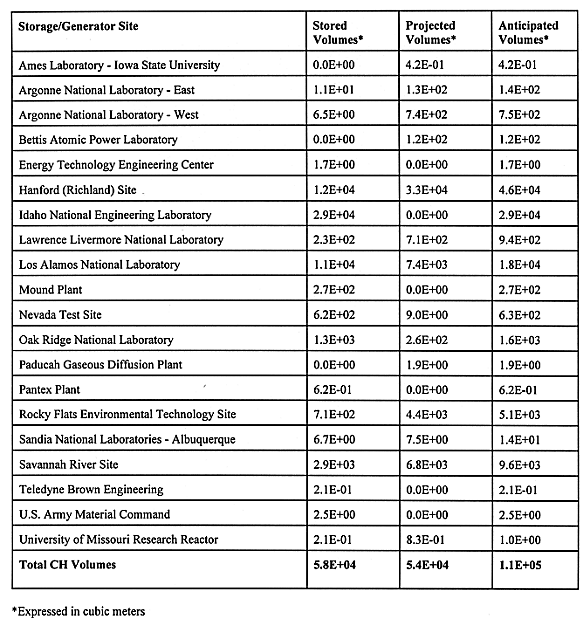
Table II WIPP RH-TRU Waste Anticipated Inventory by Site
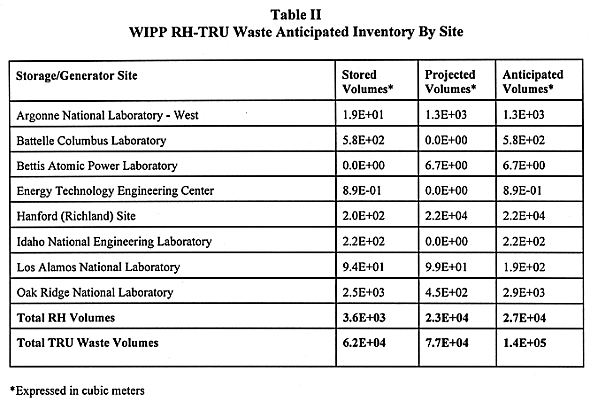
Table III WIPP Waste Material Parameter Disposal Inventory
Radionuclide Disposal Inventory
Each year the TRU waste sites report the total amount of radionuclides that are present in the TRU waste generated during that calendar year. Historical information is available from the TRU waste sites for each year of TRU waste generation since 1970. This information provided by the sites has not been adjusted for subsequent radioactive decay since time of waste generation. This information is only available for stored TRU waste.
Calculation of a disposal radionuclide inventory requires several steps:
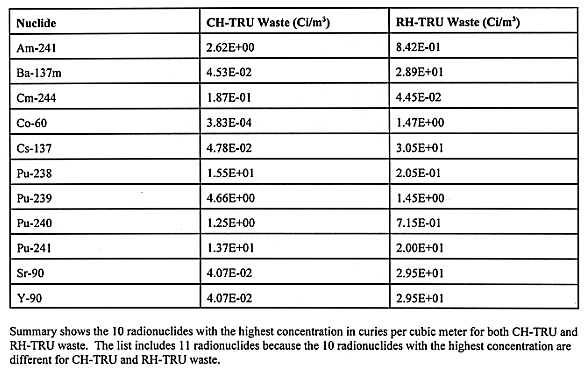
The resulting data are reported by radionuclide, separately for CH-TRU and RH-TRU waste, in the TWBIR in terms of a concentration (curies/m3) across the entire TRU waste system and total curies in the full WIPP repository. Table IV summarizes the ten radionuclides with the highest concentration (curies/m3) in CH-TRU and RH-TRU waste.
Table IV Summary Radionuclide Inventory
REFERENCES
*Present address: Fluor-Daniel Corporation, Richard, WA